clinical research

Advancing Clinical Research in Transverse Tibial Transport

SMILE-TTT study logo

Surgical MIcrovascularization of Lower Extremities for Diabetic Foot Ulcers – Transverse Tibial Bone Transport Study

Biodynamik, Inc. is proud to sponsor the SMILE-TTT Study (Surgical MIcrovascularization of Lower Extremities for Diabetic Foot Ulcers – Transverse Tibial Transport), a prospective, randomized clinical study designed to further evaluate the use of Transverse Tibial Transport (TTT).

why it matters

As the first FDA IDE-approved pivotal U.S. randomized trial of Transverse Tibial Transport for diabetic foot ulcers, the SMILE-TTT Study represents a significant step toward strengthening the clinical evidence surrounding this innovative surgical technique.

study registration

SMILE - TTT

Surgical MIcrovascularization of Lower Extremities for Diabetic Foot Ulcers – Transverse Tibial Bone Transport Study

study details

Transverse Tibial Transport (TTT) in the Management of Chronic Diabetic Lower Extremity Wounds

A CLOSER LOOK

What is TTT?

The primary objective of this clinical study is to evaluate severe diabetic foot ulcer (DFU) healing rates following Transverse Tibial Transport (TTT) with the Biodynamik XT3 System

Transverse Tibial Transport (a technique used to grow bone) is a medical technique used to

encourage limb blood flow. It works by creating a bone segment via a surgical cut into the bone

(osteotomy) and gently pulling on the thin tissue covering the bone (called the periosteum). This tissue plays a key role in encouraging the blood flow to your feet and ankles.

Studies conducted outside of the United States using Transverse Tibial Transport show it can be a helpful treatment for difficult-to-heal diabetic foot ulcers, especially in patients who can’t handle more intensive surgeries. Research has found that creating this cut in the bone (osteotomy) and pulling on it (periosteal distraction) can speed up wound healing and improve blood flow in the limb. This method is called Tibial Cortex Transverse Transport (TTT) and has been shown to help save the limb (leg in this case) and heal ulcers.


This procedure is useful for patients who would otherwise be likely to require an amputation.

This minimally invasive procedure is being studied to determine whether it is safe and effective for treating diabetic foot ulcers (DFU). The safety and effectiveness of this procedure for treating diabetic foot ulcers is not yet known.

TTT has been shown to increase measurable markers of healing (growth factors) in the body when blood is sampled. Growth factors are natural substances in the body that help cells grow, heal, and repair themselves. They act like signals, telling cells to start the process of building new tissue, repairing damage, or growing blood vessels.

Mechanism of Action

A small, surgically planned fracture in the tibia triggers the body’s healing cascade, forming a hematoma that activates immune cells and growth factors.

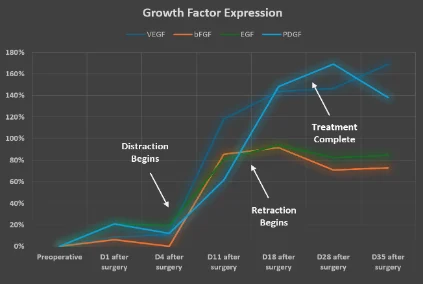
VEGF, IGF, EGF, and PDGF rise during distraction and stay elevated through retraction and recovery, extending the window for repair.

Chart of growth factor levels (VEGF, IGF, EGF, PDGF) from before surgery through distraction, retraction and the end of treatment

doi:10.1111/os.13416

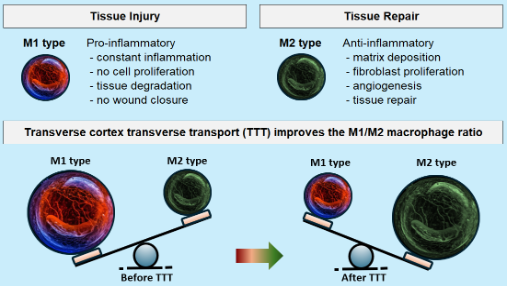
Gradual tension shifts macrophages from the pro-inflammatory M1 type to the reparative M2 type, releasing factors that support tissue regeneration.

Diagram comparing M1 (pro-inflammatory) and M2 (reparative) macrophages before and after transverse tibial transport

doi:10.1302/2046-3758.114.BJR-2021-0364.R1

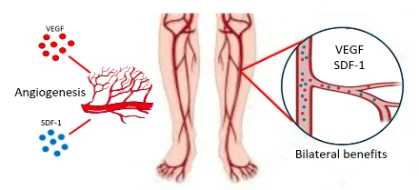
New blood vessels form and microcirculation is restored, delivering oxygen and nutrients that ischemic tissue needs to heal.

Illustration of new blood vessel formation (angiogenesis) in both legs, with VEGF and SDF-1 signaling

DOI: 10.1016/j.jot.2023.08.002

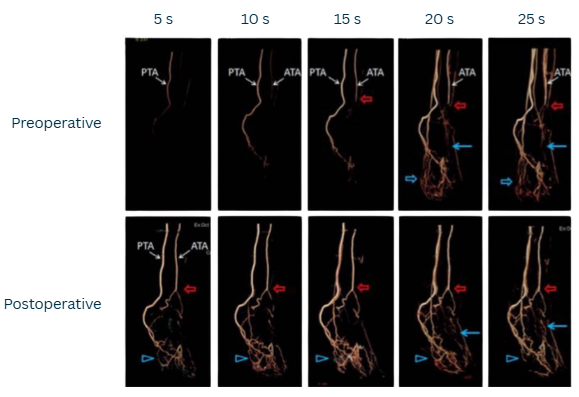
CT angiography of the lower leg and foot at 5 to 25 seconds, before and after surgery

CTA Images reveal angiogenesis through newly grown blood vessels extending into peripheral tissues.

Chen Y, Kuang X, Zhou J, et al. Proximal tibial cortex transverse distraction facilitating healing and limb salvage in severe and recalcitrant diabetic foot ulcers. Clin Orthop Relat Res. 2020;478(4):836-851. doi:10.1097/CORR.0000000000001075

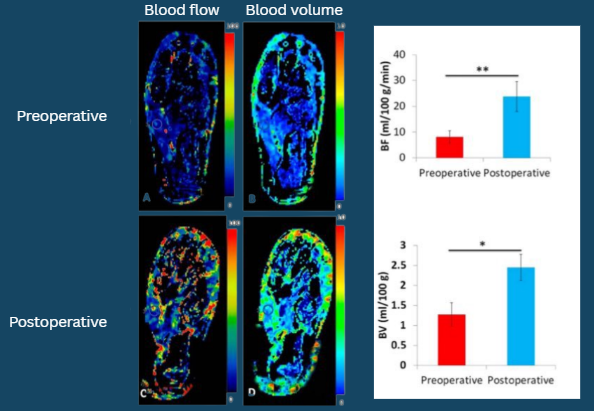
Perfusion maps and charts of blood flow and blood volume in the foot, before and after surgery

Increased perfusion results in greater blood volume and improved blood flow

Chen Y, Kuang X, Zhou J, et al. Proximal tibial cortex transverse distraction facilitating healing and limb salvage in severe and recalcitrant diabetic foot ulcers. Clin Orthop Relat Res. 2020;478(4):836-851. doi:10.1097/CORR.0000000000001075

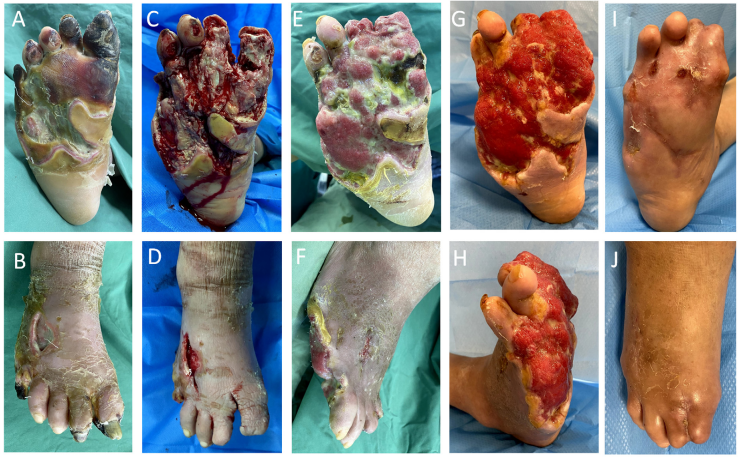
Clinical photos of a diabetic foot ulcer at successive stages of treatment, labeled A to J

Results indicate accelerated healing, with 93% of patients healed by six months compared to 41% with conventional treatments

Chen Y, Ding X, Zhu Y, Jia Z, Qi Y, Chen M, et al. Effect of tibial cortex transverse transport in patients with recalcitrant diabetic foot ulcers: a prospective multicenter cohort study. J Orthop Translat. 2022;36:194-204. doi:10.1016/j.jot.2022.09.002

Questions about the study?

Reach out to our team to learn more about the SMILE-TTT Study or participation criteria.

XT3 is not FDA-cleared or approved for diabetic foot ulcers; its safety and effectiveness for this use have not been established. Biodynamik has been authorized to investigate this indication in the SMILE-TTT trial under FDA-approved IDE G260049.